MODULE 11
Recognition of Malocclusion
Ortho assessment
- The patient’s and/or carer’s awareness of the malocclusion (presenting complaint)
- Their general level of dental awareness
- An extra-oral examination of facial form (skeletal pattern and soft tissue)
- General oral condition – oral hygiene and tooth quality
- Presence of all or absence of teeth
- The alignment and form of each arch
- The teeth in occlusion
- Radiographic assessment – orthopantogram
- Good quality study models
- Clinical photographs.
IOTN
- two components
- dental health
- aesthetic
Dental health component
- Grade 1 - no need for treatment
- Grade 2 - slight need for treatment
- Grade 3 – borderline need for treatment
- Grade 4 - need for treatment
- Grade 5 - great need for treatment
- following characteristics are assessed, most severe trait in the grade selected
- missing teeth
- overjet
- crossbite
- contact point displacement
- overbite
Grade 1 (None)
- 1 Extremely minor malocclusions including contact point displacements less than 1 mm.
Grade 2 (Slight)
- 2a. Increased overjet greater than 3.5 mm, but less than or equal to 6 mm with competent lips.
- 2b. Reverse overjet greater than 0 mm but less than or equal to 1 mm.
- 2c. Anterior or posterior crossbite with less than or equal to 1 mm discrepancy between retruded contact position and intercuspal position.
- 2d. Contact point displacements greater than 1 mm but less than or equal to 2 mm.
- 2e. Anterior or posterior open bite greater than 1 mm but less than or equal to 2 mm.
- 2f. Increased overbite greater than or equal to 3.5 mm without gingival contact.
- 2g. Pre- or post-normal occlusions with no other anomalies (includes up to half a unit discrepancy).
Grade 3 (Borderline need)
- 3a. Increased overjet greater than 3.5 mm, but less than or equal to 6 mm with incompetent lips.
- 3b. Reverse overjet greater than 1 mm, but less than or equal to 3.5 mm.
- 3c. Anterior or posterior crossbites with greater than 1 mm, but less than or equal to 2 mm discrepancy between retruded contact position and intercuspal position.
- 3d. Contact point displacements greater than 2 mm, but less than or equal to 4 mm.
- 3e. Lateral or anterior open bite greater than 2 mm, but less than or equal to 4 mm.
- 3f. Deep overbite complete on gingival or palatal tissues, but no trauma.
Grade 4 (Need treatment)
- 4h. Less extensive hypodontia requiring pre-restorative orthodontics or orthodontic space closure to obviate the need for a prosthesis.
- 4a. Increased overjet greater than 6 mm, but less than or equal to 9 mm.
- 4b. Reverse overjet greater than 3.5 mm with no masticatory or speech difficulties.
- 4m. Reverse overjet greater than 1 mm but less than 3.5 mm with recorded masticatory and speech difficulties.
- 4c. Anterior or posterior crossbites with greater than 2 mm discrepancy between retruded contact position and intercuspal position.
- 4l. Posterior lingual crossbite with no functional occlusal contact in one or both buccal segments.
- 4d. Severe contact point displacements greater than 4 mm.
- 4e. Extreme lateral or anterior open bites greater than 4 mm.
- 4f. Increased and complete overbite with gingival or palatal trauma.
- 4t. Partially erupted teeth, tipped and impacted against adjacent teeth.
- 4x. Presence of supernumerary teeth.
Grade 5 (Great Need treatment)
- 5I. Impeded eruption of teeth (except for third molars) due to crowding, displacement, the presence of supernumerary teeth, retained deciduous teeth and any pathological cause.
- 5h. Extensive hypodontia with restorative implications (more than 1 tooth missing in any quadrant) requiring pre-restorative orthodontics.
- 5a. Increased overjet greater than 9 mm.
- 5m.Reverse overjet greater than 3.5 mm with reported masticatory and speech difficulties.
- 5p. Defects of cleft lip and palate and other craniofacial anomalies.
- 5s. Submerged deciduous teeth.
Aesthetic component
- 10 photographs showing different levels of dental attractiveness
- grades 1-4 - little or no treatment on aesthetic grounds
- grades 5-7 - borderline need for treatment
- grades 8-10 - would clearly benefit from orthodontic treatment
Ortho referral
- refer earlier rather than later
- include likely compliance of family to orthodontic treatment
- oral hygiene
- prognosis of teeth
- relevant radiographs
Preventive and Interceptive Orthodontics
Loss of primary canine
- matter of great concern
- maxillary, if primary canine removed before CI and lateral incisors have moved together, likely to lead to incisor spacing and labioversion of the permanent canine
- mandible, may lead to lingual tipping of four mandibular incisors and blocking out of permanent canine
Loss of first primary molars
- if lost prior to eruption of 6s, would lead to mesial shift of E
- less likelihood of space loss if 6s are in occlusion
- little chance of loss of arch perimeter if lost during eruption of the 4
loss of secondary primary molar
- more damaging than loss of the D
- 6s drift forward immediately
- greatest loss when D lost prior to 6 eruption
Ankylosis
Ankylosis
- deciduous molars 1-9%
- ankylosis - fusion between cementum and dentine of tooth and bone of alveolar process
- mandibular first primary molar most common
- unclear aetiology
- wait for eruption of 1st permanent molars before surgical exo
- if there is evidence of root resorption, no indication for early removal
- surgical exo only if preventing eruption of succedaneous tooth
- space maintainer if early exfoliation
Appliance treatment in mixed dentition
removable
- adams cribs
- two z springs
- anterior cross bite
- pseudo class III
- inclined plane
- tongue blade
- one permanent incisor in cross btie without excessive overtbite
- can use tongue blade or paddle pop stick to lever against it
- put paddle pop stick lingual to it and bite against it while holding the other end of the paddle pop stick, use for 1 minute 6 times per day, interval of atleast half an hour
- correction usually complete within a few days
- posterior cross bite
- maxilalry appliance with a mid palatal expansion screw
- quad helix
- RME
Anomalies of eruption
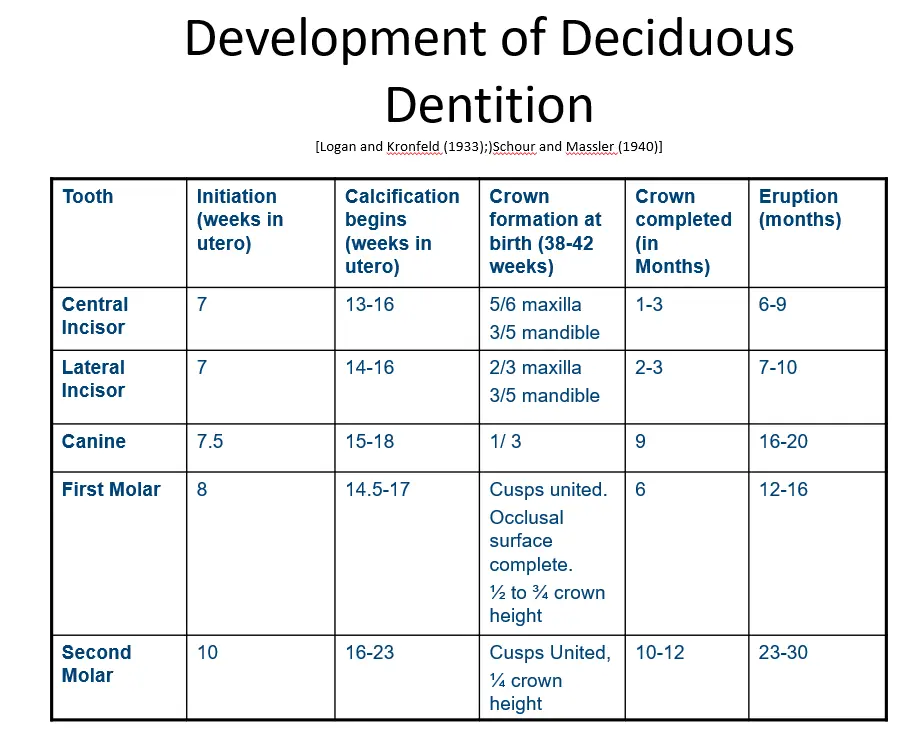
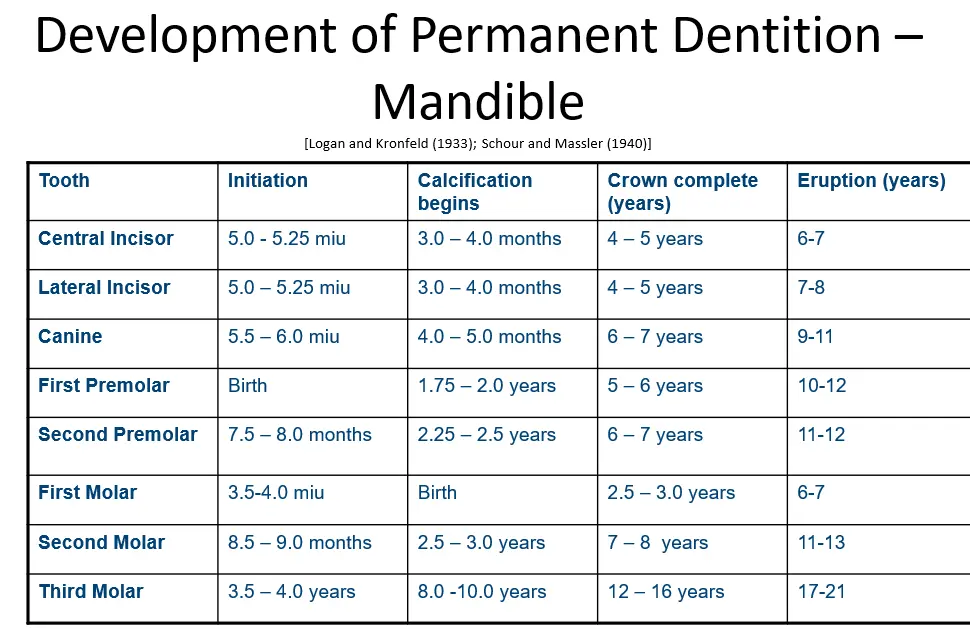
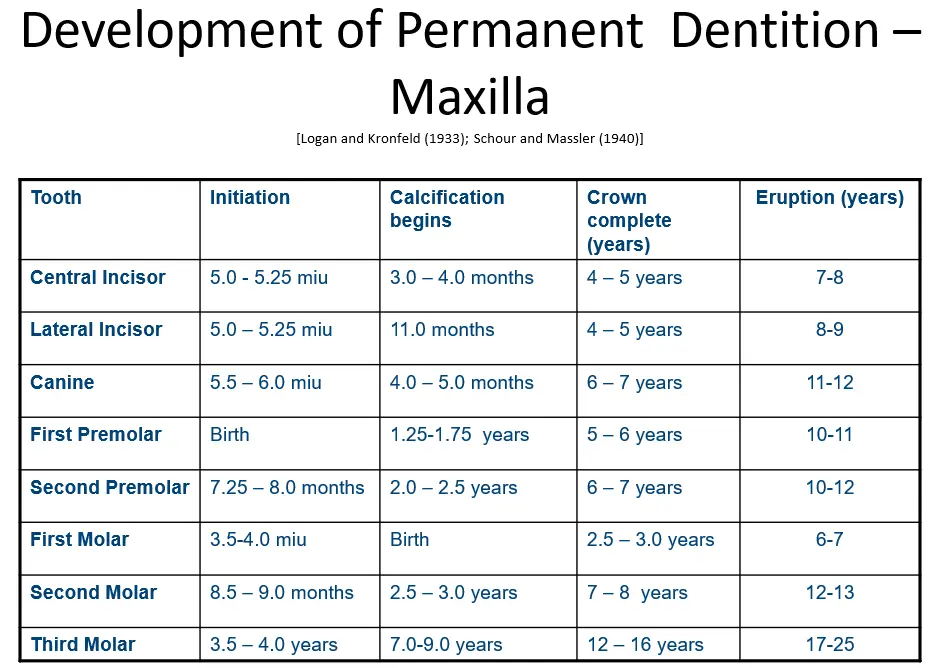
Ectopic eruption of first permanent molars
- usually due to inadequate arch laength
- take radio to confirm presence of premolar
- more common in maxilla
- space regaining appliance to upright maxillary 6s to regain space,
Ectopic eruption of permanent canine
- majority in palatal
- 2% in maxilla
- investigate if not palpable at age 9-10
Parallax technique
- slob rule
Supernumerary teeth
- if obstructing eruption path of adjacent tooth, or has associated pathology, should be removed as soon as convenient
- risk vs benefit