Occlusion
Canine guidance vs group function
- canine
- posterior and incisor teeth completely discluding
- group
- intercuspal even
- working side contact shared evenly between posterior teeth with lateral and central incisors discluding
occlkusion in rempros
- bilateral balance
- concern of nonworking side balancing, cusps and cuspal angulation, placement of teeth in relation to ridge
Definitions
Terminal hinge axis THA and retruded arc of movement
- axis which passes through both condyles
- mandible rotates in this axis in its most retruded/comfortable position
- most useful for complete dentures, some crown and bridge too
- measured via ear-bow
intercuspal position
- position of maximum contact and maximum intercuspation
- most cranial position of the mandible
centric relation
- centricitiy of condyles in the glenoid fossa
retruded contact position RCP
- most retruded position of mandible with teeth together
- some patients cannot manipulate their jaw into it
- only 10% of RCP coincides with ICP
- may be up to 2mm posterior to ICP
mandibular movements
- for those with discrepancy for RCP and ICP, usually close straight into ICP from rest position
- in dental chair may be a bit more abnormal
- contact can occur between ICP and RCP during empty swallowing, during mastication of tough bolus, and parafunctional activity
- four mandibular movements from ICP, termed excursions:
- retrusive
- protrusive
- left lateral
- right lateral
Retrusive movements
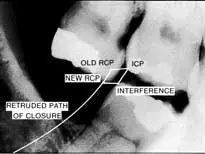
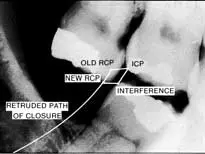
- movements between ICP and RCP are guided by a limited number of opposing pairs of cusps of posterior teeth
- angle of slide, length, individual pairs of teeth that produce it are important
- unevenness of movement producing bulge/lump is concerning
- these disturbances to smooth movement are a form of occlusal interference
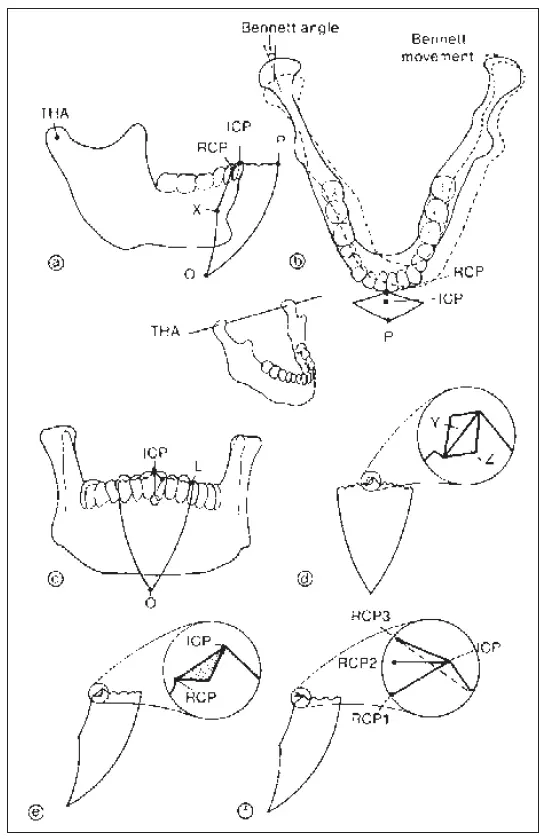
- a
- maximum possible movement of the tip of a lower incisor
- fully protruded position P (teeth are in occlusion from RCP to P)
- X is maximum opening that can be made without condyles moving forwards
- O is maximum opening wiht condyles fully protruded
- in opening from RCP to X, mandible rotates in pure arc of the THA (which passes through the condles)
- b
- view from above
- RCP and ICP are not pure arcs of circles, because when mandible moves laterally, condlye on working side shifts laterally (bennett movement), and condyle on non working side moves forwards and medially (bennet angle) (one shifts one swings)
- c
- border movements from frontal view
- movement from ICP to cusp to cusp contact is either guided by canines, all anteriors or a group of posteriors
- from C to lateral position L, guidance is irregular and controlled by anterior teeth or teeth on non working side, which is an on functional range and not usually involved in parafunctional activity (little importance)
- d
- changes in lateral guidance may either expand original border movement (Y) or encroach upon it (Z), both are occlusal intereference
- Y would result from fracture or extraction of a canine that may have previously governed lateral guidance
- Z may result from overbuilding the cusps of a posterior crown in a group functional occlusion or from development of a non working side contact
- e
- occlusal intereference which is developing in smooth movement from ICP to RCP, can be caused by crown, overruption, extraction
- f
- expansion of border movement is common objective in range of ICP to RCP
- ICP to RCP1 us standard movement
- ICP to RCP2, removing the large vertical component of the movement to produce a long centric so that the movement was flat,
- ICP to RCP3 becoming coincident, requires multiple resto + occlusal adjustment, need to either encroach on border movement space or removal substantial tooth tissue, known as reorganising occlusion
- if ICP left undisturbed, occlusal plan is "conformative"
Protrusive excursion
- in forward movement of mandible with teeth together, usually incisors that guide movement, unless pt is anterior open bite or class III incisor
- angle and length of movements determined by incisor relationship
- class II div II with increased overbite and reduced overjet, movement of mandible has to be vertically downwards before it can move forwards
- sometimes its best to reproduce patients existing guidance (normal shape teeth), sometimes its best to alter incisor guidance (worn teeth)
left and right lateral excursions
- working side - side that the mandible is moving to
- non-working side is opposite side mandible is moving to
- contacts on working side are either canine guided or between groups of teeth on working side (group function)
- occasionally individuals pairs of posterior teeth will guide occlusal in lateral excursion, but this is not ideal
- canine guidance is protective of posterior teeth
- contact on non workign side in lateral excursion shouldnt occur, however it does sometimes occur after extractions and over eruption, or ortho, or in cases of posterior crossbite
Occlusal interferences and occlusal harmony
Occlusal interferences
- a contact between teeth in one of the excursion of mandible so that the free sliding movement is interrupted or uneven, or as guidance of mandible being carried on teeth that are unsuitable for
- most cases, occlusal interferences are result of dental treatment
- interferences are difficult to detect because sensory mechanism of PDL can detect the interference and triggers mandibular movement pattern to avoid it
- this is main reason why some patients have difficult getting into RCP and difficult in voluntary lateral excursion with teeth together
- interferences should be suspected if patient has difficult in manoeuvring the mandible into reproducible RCP
- can detect interferences by resting finger under patients chin whilst patient performs various interferences
Occlusal harmony
- absence of occlusal interferences
- smooth comprehensive movement in all excursions without strain or discomfort, and wont cause harmful effects to the teeth
- usually includes shallow angles of movement in guidance from ICP in all four directions
- some patients will not having free sliding movements, but have adapted to their occlusal interferences and there is no need for treatment
- but if occlusion is altered to produce new/different occlusal interferences, patients neuromuscular mechanism will experience difficulty in adapting to these, resulting in damage to teeth, TMD pain, muscle pain, spasm, postural/functional problems
Premature contact
- only used for complete dentures
- no natural ICP, ICP and RCP coincident in complete dentures
- if they don't coincide, patient may close into retruded path of closure, and then slide into ICP, or dentures may move
- artificial teeth don't have a periodontal proprioceptive system, so position of artificial ICP cannot be detected
Occlusal stability
- an occlusion in which over eruption, tilting and drifting of teeth cannot occur and cause new occlusal interferences
- must be sufficient posterior contacts to prevent general collapse of posterior occlusion resulting in loss of OVD
- all teeth should have occlusal contact with another tooth or prosthesis, mesial drifting should be prevent by presence of contact point or prosthesis, or by adequate cuspal locking with opposing teeth in intercuspal position
Occlusal vertical dimension
- relationship between mandible and maxilla with teeth in ICP
- faceheight with teeth in occlusion
- usual to measure difference between rest position and ICP (freeway space) to give indication to normal range OVD
- normal freeway space may be 2-5mm or more
- in most cases with crowns and bridges, OVD is satisfactory
- in some OVD reduced by exo tilting, drifting and collapse, which its then necessary to restore original occlusal level for aesthetic and technical reasons
- in some cases, wear has resulting in short teeth, but no loss of facial height due to over eruption, then we must decide
- accept that natural and artificial crowns will be short
- create interocclusal space between teeth to be crowned without altering other occlusal relationships
- artificially increase OVD by restoring or replacing all occlusal surfaces in one or both jaws
- artificially lengthen clinical crown by gingival or alveolar surgery
- or combination of all
- when change in OVD is planned, usual to assess tolerance of patients neuromuscular mechanism to the change
- removable acrylic plate covering all occlusal surfaces by one arch increasing OBD by same amount as proposed to final restorations may be fitted, alternatively teeth may be built up with temp crows or composite
- temporary adjustment left for several weeks to ensure no problems with neuromuscular mechanism before permanent change is made
Creating interocclusal space for teeth to be crowned
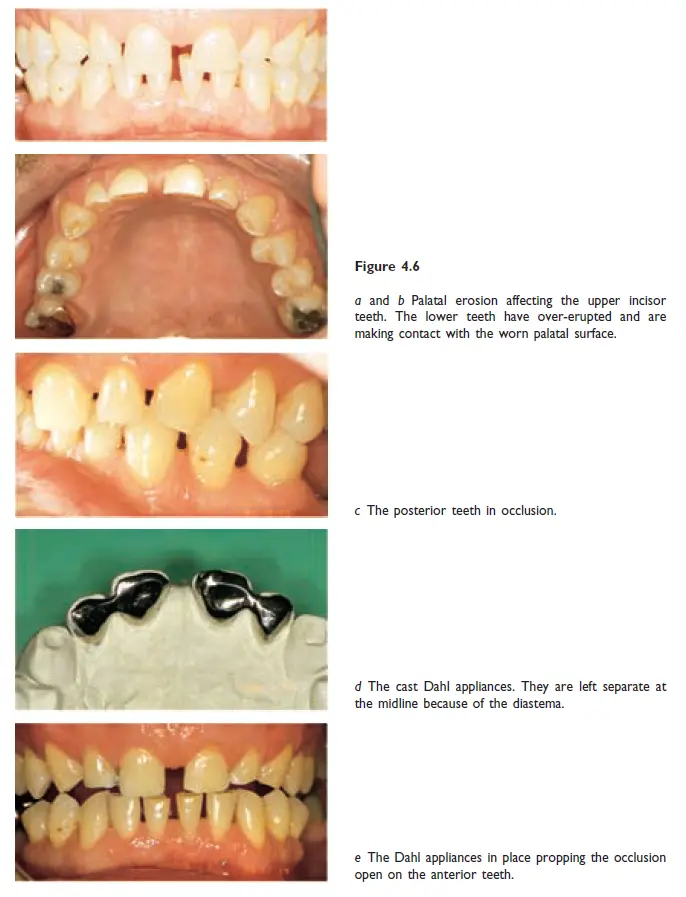
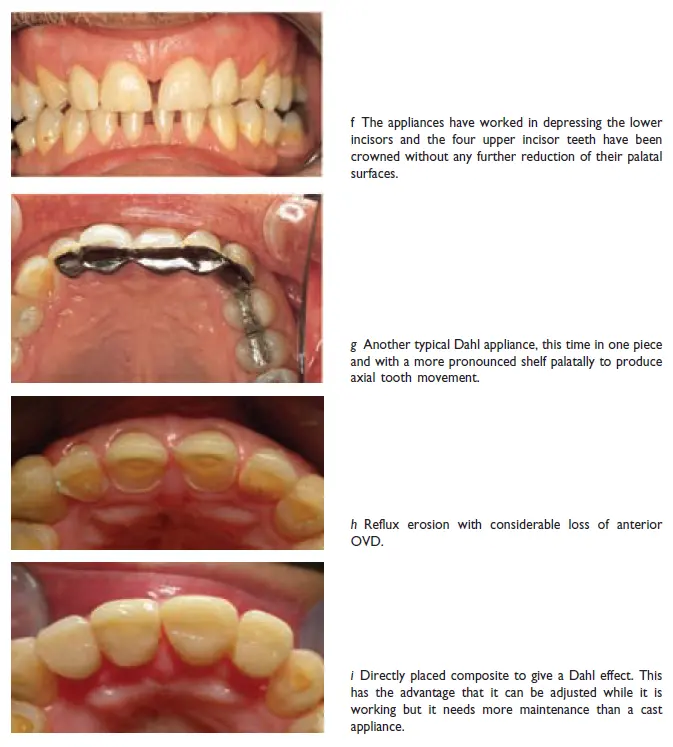
- in some circumstances, usually extreme anterior wear, helpful to have some minor ortho to enable crown prep without further prep of worn surfaces
- can use a dahl appliance, which is cast CoCr as an anterior biteplane to open up the occlusion in about 3 months
- can also build up with composite or fitting acrylic provisional crowns which are high in occlusion
Temporomandibualr dysfunction
- combo of symptoms including tenderness, pain and tension in MOM and pain, clicking and limitation of movements in TMJ
- most cases have symptom resolution spontaneously
- can see changes in the joints from MRI
- but once you get the MRI, alot of patients with no symptoms seem to have displaced discs, and alot of symptomatifc patients will have this used to explain their issues
- balanced hypothesis
- occlusal interferences produce conditioned patterns of muscle activity that avoid these interferences, which increased basic level of muscle activity
- if this is increased by stress or anxiety, it may raise muscle tension above a threshold which causes symptoms to develop
- simple way to detect whether alteration of occlusion is likely to reduce symptoms of mandibular dysfunction is to provide a michigan splint (tanner splint is the lower jaw version)
- if symptoms improve then its a clear indication that occlusion has something to do with the symptoms
- if you make an acrylic biteplane (like a michigan splint), and then it provides the patient relief, so they keep wearing it, and the biteplane wasnt with even occlusion on all teeth, it will produce orthodontic forces to the teeth.
- usually just need some occlusal adjustment by grinding selected parts of occlusal surfaces, if its obvious, can just do it directly
- if not amazingly obvious or needing extensive adjustment, best to produce articulated study casts set up in a semi adjustable articulator with a mock adjustment
Clinical Examination of the occlusion
notable points
- pt complaints of TMJ pain, muscle spasms, unexplained chronic dental pain
- ease/difficulty of different excursions and if they can be made voluntarily
- occlusal interferences and if proposed restorations will influence them
- mobility of teeth
- presence angle and smoothness of RCP to ICP
- type of lateral guidance and degree of contact
- presence of any contact on non working side
- location, extent and faceting of the teeth to be restored
- signs of excessive wear
- degree of stability of occlusion and whether proposed restorations will influence stability
- over erupted and tilted teeth
Clinical Aids
articulating paper
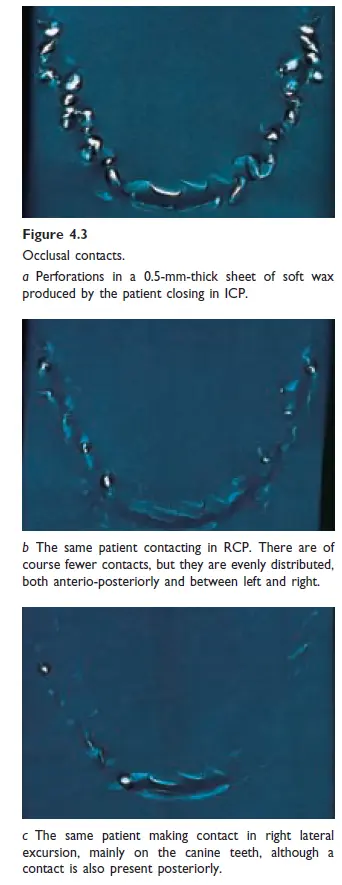
- paper/plastic foil used to mark occlusal contacts in different excursions
- depends on thickness of paper, can use multi colours to give best image
Wax
- can be removed from teeth and placed on study casts for occlusal contacts to be studied more closely
Occlusal reg silicones
- better than wax because it starts soft then hardens, and can easily be transferred betweem mouth and cast
- less viscosity means its less likely to guide mandible into wrong position
Plastic strips
- used to test if teeth are making contact in various excursions, can use mylar strip too
Study casts
- useful for assessing stability of occlusion in ICP and examining wear facets
- havet obe good quality and trimmed to allow proper contact of t eeth
- best is silicone or polyether impressions
- Articulated casts
- if non articulated is not enough
- need facebow, bite reg/record, with protusive, ICP and lateral excrusion record
Occlusal adjustments prior to tooth preparation
- may be necessary in cases of over eruption, occlusal plane alteration
- but still need sufficent tooth structure remaining on tooth to be prepared
Occlusal objectives in making crowns and bridges
Main objectives
- leave occlusion with no additional occlusal intereferences (harmonious)
- to le4ave the occlusion stable
Secondary objectives
- distribute guidance in one of the excursions more evenly between a number of teeth
- when a canine tooth that previously guided occlusion is extracted, lateral forces should be distributed evenly and as widely as possible between remaining posterior teeth
most of the time
- RCP and ICP are established, we dont want to alter them, so best to take a conformative approach
- unless
- so many surfaces being restored that ICP will inevitably be altered
- ICP is unsatisfactory
- OVD being altered
- symptoms of TMD
- then we try to restore with ICP to coincide with RCP (reorganised appraoch) and place them at a comfortable OVD which is same or maybe restored if previously lost
- for all major reconstructions, need 3-6 months of provisional to establish new OVD and occlusal functional relationships
Clinic and lab management of occlusion
avoid loss of occlusal relationships
- if occlusal surfaces are being removed from a number of teeth or if the teet hare crucial to guidance, occlusal reg should be done before tooth prep
- if you prep first and dont take reg, youll lose record of original OVD, can leave just one pair of teeth each side however and then prep to get coincident ICP RCP, then take impression, then prep and further impression.
- can do same by making 1 pair of crowns each side first, and then the rest
Maintaining occlusal relationships with temp restos
- prepared teeth and their opponents will over erupt unless occlusion is re established by means of adequate temp restorations, and contact points have to be kept otherwise they can drift together
- more important in longer periods and younger patients who are more prone to movement
Recording occlusion
Hand held models
- most common problem is that posterior resto made high and not detected because its hard to see tiny spaces between pairs of opposing teeth adjacent to resto
Simple hinge articulator
- adequate if sufficient unprepared intercuspating teeth and resto to be made occluding in ICP
- can easily identify on the working cast if its made high etc and can be adjusted before insert
semi adjustable articulator
- arcon design
- intercondylar distance variable
- maxillary cast relative to approximation of THA
- condylar guidance is variable
- some adjustment of incisal guidance
- use semi adjustable if occlusal relationships other than ICP are important
- use facebow etc to record with intraocclusa record of protrusive and lateral excrusion
fully adjustable articulator
- sometimes used if its really necessary, but long term provisional restorations with adjustments over time achieve about the same results
Lab stages
- trim the cast
- most common cause of high resto is cast distortion
- trim out air bubbles from alignate impression, but mostly focus on no air bubbles being created when taking the impression
- articulate
- use as small amount of plaster as possible, as plaster expansion will distort relationship
- shape occlusal surface
- build up wax and carve it back to make it ideal, then check occlusal contacts
- small increments of molten wax flowed from tip of an instrument to build up cones forming a cusps, can use this method to check excursions from the beginnign rather than at the added
- can also shape occlusion with porcelain piece by iece
- adjusting occlusion
- articulating paper and foil, can even grit blast metal surface lightly which will burnish in contact
- adjusting in intercuspal position
- usually you can trim with or without LA and the patient will notice, just standard articulating paper or articulating silk.
- adjustments in lateral, protrusive, retrusive excursions
- examine for intereferences and adjust as necessary
- crown displacement during movement with teeth in contact etc.
- stability
- final stabiltiy made by confirming presence of centric stops on restoration and adjuacent teeth, adequacy of contacts checkign with floss
- adjustment techniques
- ICP adjusted first
- centric stops marked with articulating paper
- interferences marked with different colour and adjusted
- metal and porcelain can be adjusted with mounted stones or diamond burs
- metal finished wit hfinishiing burs and polished with mounted rubber wheels or points
- porcelain finished with mounted points or composite polishing discs